
Lee County Parole and Probation
Parole and probation can both place a person under South Carolina Department of Probation, Parole and Pardon Services supervision, but they begin in different ways. Parole follows confinement. The South Carolina Board of Paroles and Pardons authorizes a person to serve a remaining part of an eligible prison sentence in the community under stated terms. Probation comes from a court sentence. A judge may order it without an SCDC prison term, after a suspended term, or as part of a sentence structure shown in the court docket. Neither status is shown by the ordinary SCDC current-inmate search because that tool covers people still incarcerated in SCDC.
The distinction affects proof. A parole record should align with SCDC release information, a Board action when applicable, and SCDPPPS supervision. A probation record should align with the sentencing order and SCDPPPS. A person may also appear under community supervision, supervised reentry, supervised furlough, or another agency category. Read the precise label. Do not translate every supervision status into parole.
| Point | Parole | Probation |
|---|---|---|
| How it begins | Release from eligible prison confinement under Board authority | Court sentence, often with all or part of confinement suspended |
| Primary legal record | SCDC release data and Board result | Sentencing order and case docket |
| Current operational source | SCDPPPS supervision record and office | SCDPPPS supervision record and office |
| What it does not prove | A grant alone does not prove physical departure | A sentence entry alone may not show current compliance |
- Parole
- Conditional community release during an eligible prison sentence.
- Probation
- Court-ordered community supervision, often tied to a suspended sentence.
- Discharge
- The agency-recorded end of a custody or supervision obligation.
- Absconder
- A person officially alleged to have left or failed to comply with supervision.
Check Lee County Supervision
The official SCDPPPS offender search is the direct online check. It offers First Name, Last Name, SID number, County, and Year of Birth. Valid search combinations include first name plus last name, SID alone, either name plus year of birth, county plus SID, or county plus either name. Search narrowly enough to avoid a same-name match. Then open the record and compare the displayed identifiers, county of supervision, and status.
- Choose the strongest identifiers available. A SID number is more exact than a common name.
- Run a supported field combination. Use Lee as county only when Lee is likely the county of supervision.
- Open the matching record and compare the identity details before relying on the supervision label.
- Note that the online information represents the prior day, not the current moment.
- Call the listed county of supervision for current-day public facts and correct office routing.
- Read the sentencing docket or SCDC release record to learn how that supervision began.
A county filter has limits. County of supervision need not be the arrest county, the committing county, or the prison location. Someone arrested in Lee County may be supervised elsewhere. Likewise, a person once housed at Lee Correctional Institution may have no Lee County case at all. If the search returns no match, try the SID or name-and-birth-year route and check the court and release records. A no-result screen does not prove that there was never supervision.
The captured SCDPPPS search screen shows the state’s exact lookup fields.
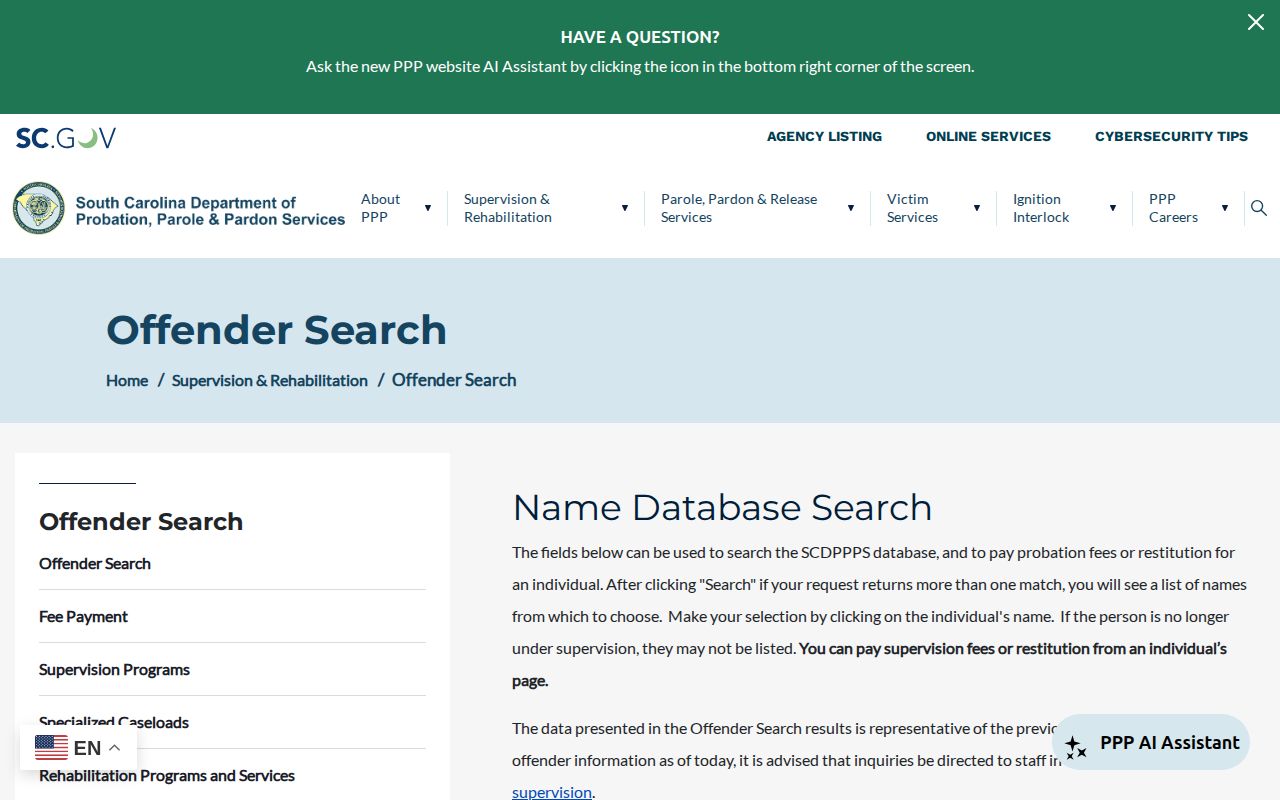
Those field choices support identity checks without assuming that the county of arrest is also the county managing supervision.
Note: SCDPPPS directs users to the supervising county office when the prior-day online snapshot needs a same-day check.
Lee County Supervision Office
Lee County has its own SCDPPPS office in Bishopville even though the regional detention center serving local detainees is in Sumter. That split is important. The jail can confirm a regional booking and custody-ending event. The supervision office is the better public contact for active probation, parole, community supervision, or related SCDPPPS categories. At the research review, the agency page identified Bill White as Agent in Charge. Staff may restrict personal detail, so frame the call around public status and correct office routing.
South Carolina DPPPS, Lee County
Street: 123 South Main Street, Room 213
City: Bishopville, SC 29010
Mail: P.O. Box 342, Bishopville, SC 29010
Phone: 803-484-5341, extension 344
Fax: 803-484-6305
Hours: Verify current public-counter hours before visiting.
The official Lee County office page is the source for current contact details and any changing jurisdiction counts.
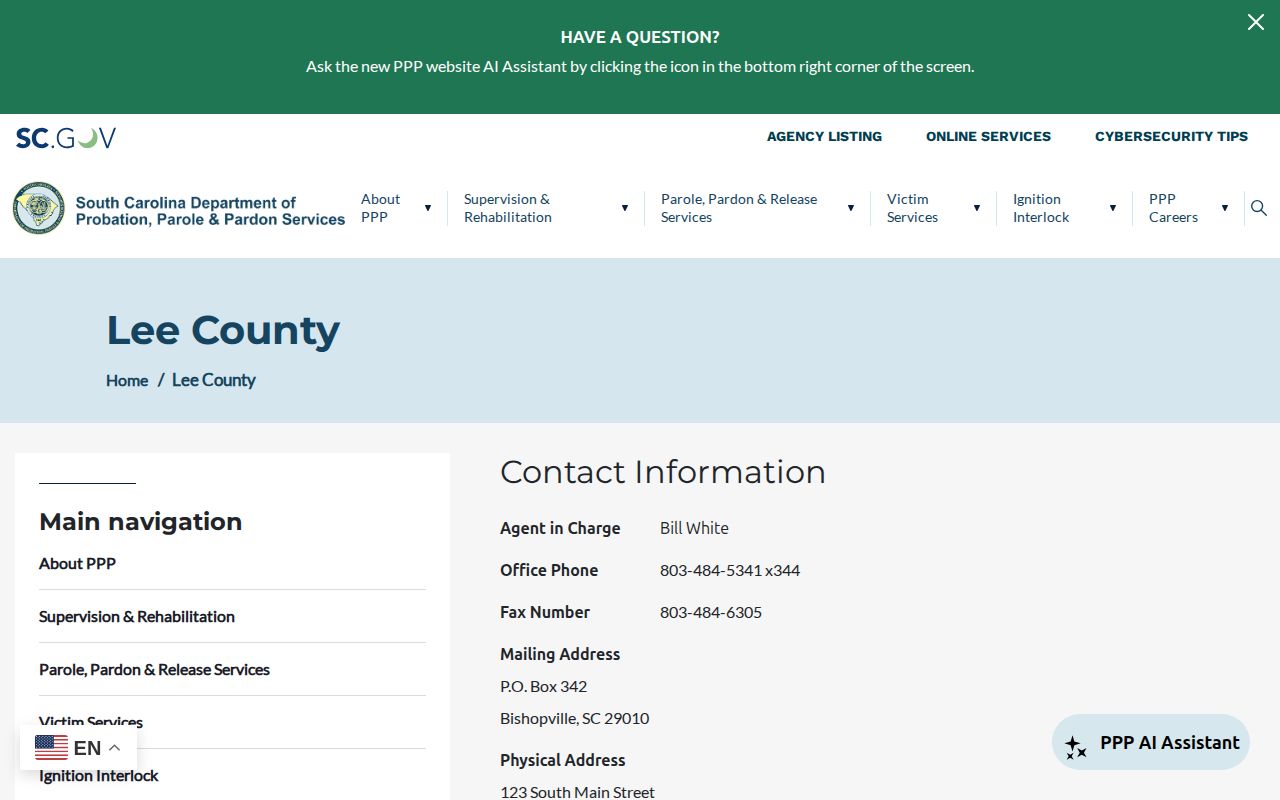
The office listing connects a Lee County supervision search to the staff who can address the prior-day delay and identify the proper supervising office.
Lee County Supervision Notifications
SC VINE adds a second public channel because its South Carolina coverage includes participating county detention centers, SCDC, and SCDPPPS. Search by offender name or number, narrow a common name with a middle initial and date of birth, and check the reporting agency on the result. A Sumter–Lee record concerns regional jail custody. An SCDC entry concerns state prison. An SCDPPPS entry concerns community supervision. Those layers may follow one another, but they are not the same record.
VINE is a notification and status aid, not a certified release or discharge record. Transfers can require a fresh registration. The state FAQ also directs crime victims who need SCDC offender notifications to register with SCDC Victim Services at 1-800-835-0304. For a full custody trail, pair the SCDPPPS result with the release source and the filed sentence. The Lee County released inmate search path explains how those custody records fit together.
Lee County Absconder Records
An absconder is not merely someone missing from a search. It is a person officially alleged to have left supervision or failed to comply. A violation can lead to a warrant, a court or administrative proceeding, and a return to custody. The label should come from an official SCDPPPS notice, law-enforcement source, or filed warrant entry. It should also carry a date because a warrant can be served, withdrawn, or otherwise change status.
The SCDPPPS Most Wanted page is curated and statewide. It is not a complete Lee County warrant index. Entries may be labeled AT LARGE or CAPTURED and may show a photo, identifiers, county, and original offense. The agency hotline is 1-888-761-6175, while emergencies go to 911. For a Lee case not on that page, consult the supervision office and the court record rather than treating absence as clearance.
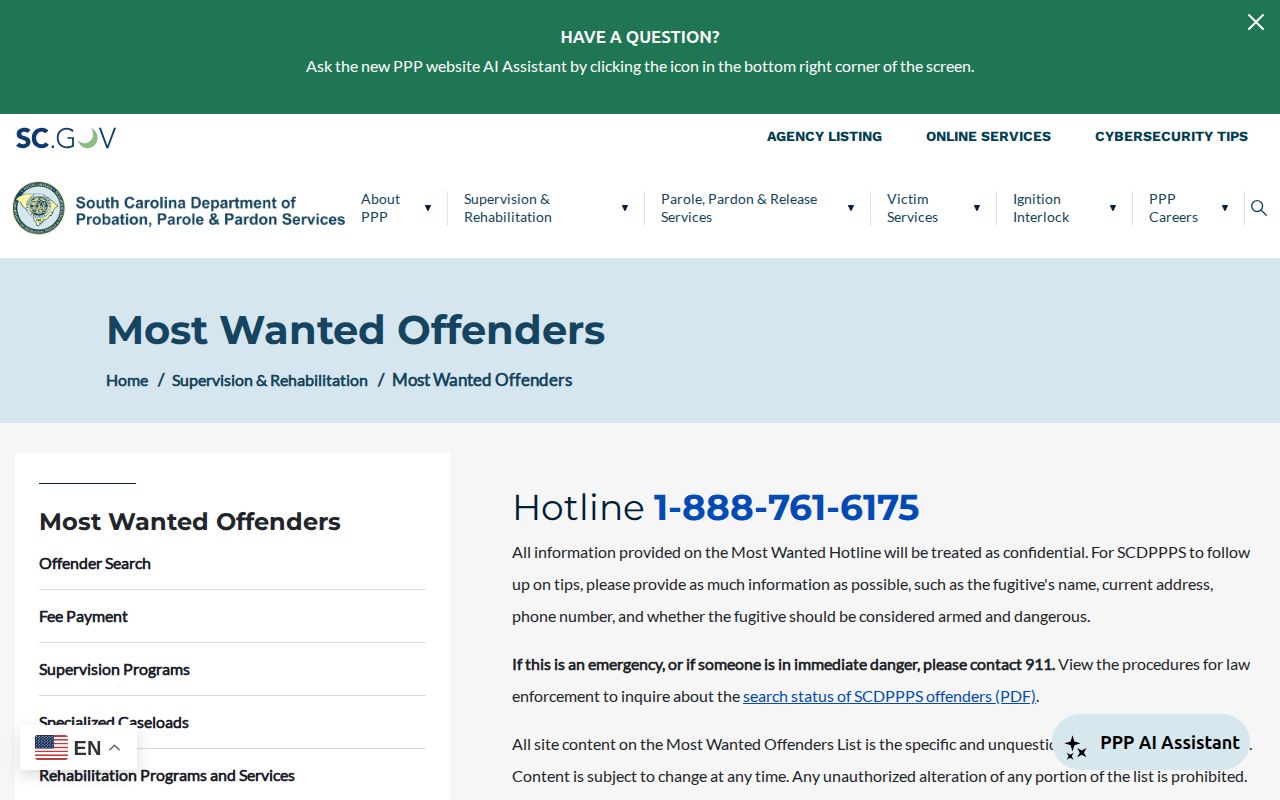
The official page’s AT LARGE and CAPTURED distinctions show why the dated agency label matters more than an old repost or search failure.
Note: Report only the current official status and identifiers; never infer a Lee County supervision violation from a missing ordinary search result.
Lee County Parole Hearing Records
The South Carolina Board of Paroles and Pardons makes parole decisions within the SCDPPPS framework. Its annual calendar separates full-board, single-panel, pardon, and administrative sessions. Dates vary by month. A live hearing search is therefore more useful than assuming a weekly pattern. Valid parole searches include first and last name, SCDC number, first name plus hearing month, last name plus month, or a month alone.
The agency says dates are generally finalized and searchable about 30 days before a hearing, though rescheduling and delayed posting can occur. Read the displayed outcome exactly. Granted means the Board authorized parole subject to processing and conditions. It does not prove that the person has left prison. Denied means parole was refused at that review. Deferred or continued indicates movement of the hearing or decision, while rescinded means an earlier action was withdrawn. Actual departure should be checked against SCDC released data, then active supervision through SCDPPPS.
The official parole hearing and results search shows its accepted combinations and timing limits.
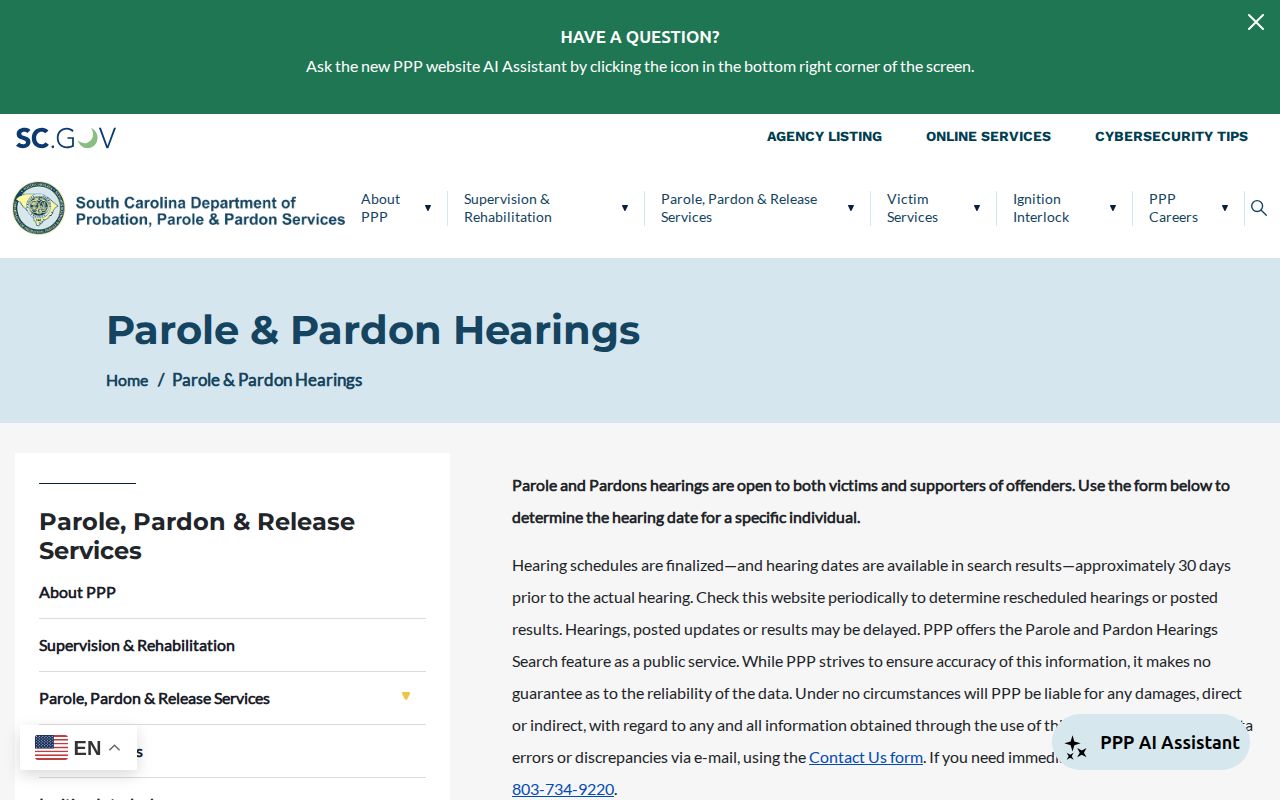
The result screen helps distinguish a Board decision from the later SCDC release event and SCDPPPS supervision start.
Lee County Supervision Discharge
Conditions are the rules attached to community supervision. Their exact terms come from the sentence, release certificate, and SCDPPPS instructions. A reported violation does not itself explain the final outcome. The supervising agency or court must resolve whether a violation was sustained and whether it changed supervision, led to a sanction, or returned the person to custody. Public records should preserve that sequence instead of collapsing allegation and result.
Discharge is the agency-recorded end of supervision. It differs from release from jail or prison, which may have started supervision months or years earlier. The strongest check combines the final SCDPPPS status with any filed discharge or court entry available for the case. South Carolina FOIA may also support a focused request for releasable portions of a supervision record, subject to privacy, law-enforcement, and other exemptions in Sections 30-4-30 and 30-4-40.
Lee County Release Identification
SCDC release policy adds a practical detail for a person leaving state prison. Identification and personal belongings retained in the institutional record are returned before departure, and the person receives an SCDC identification card with an official release sticker. This procedure applies to an SCDC release, including someone leaving Lee Correctional Institution. It is not a published Sumter–Lee Regional Detention Center rule and should not be assumed for a local jail release.
The release card can help the person navigate the first steps after custody, but it does not replace the public supervision check. A family member or authorized advocate should still use the SCDPPPS record and current supervising office for the operative parole or probation status. If another agency takes custody because of a detainer, departure from SCDC may be a handoff rather than a community arrival.