
Federal Release Custody Layers
A federal arrest does not always create an immediate BOP record. USMS may hold a pretrial detainee and use a local contract bed while the federal case proceeds. After sentencing, USMS can transport the person before BOP designates a prison. BOP becomes the main public locator for sentenced federal imprisonment and historic release data.
This sequence matters in Lee County. No federal prison was identified in Lee County, South Carolina. A local or regional jail appearance can reflect temporary federal custody, while a later BOP result reflects the sentenced system. Search the federal docket and ask which agency had physical custody at each stage.
| Stage | Primary source |
|---|---|
| Federal arrest or pretrial detention | Federal docket and USMS |
| Sentenced federal imprisonment | BOP Inmate Locator |
| Former BOP inmate record | BOP locator and BOP FOIA |
| Supervised release | Federal court and authorized probation source |
| Other-agency handoff | Receiving custodian |
Search Federal Inmate Releases
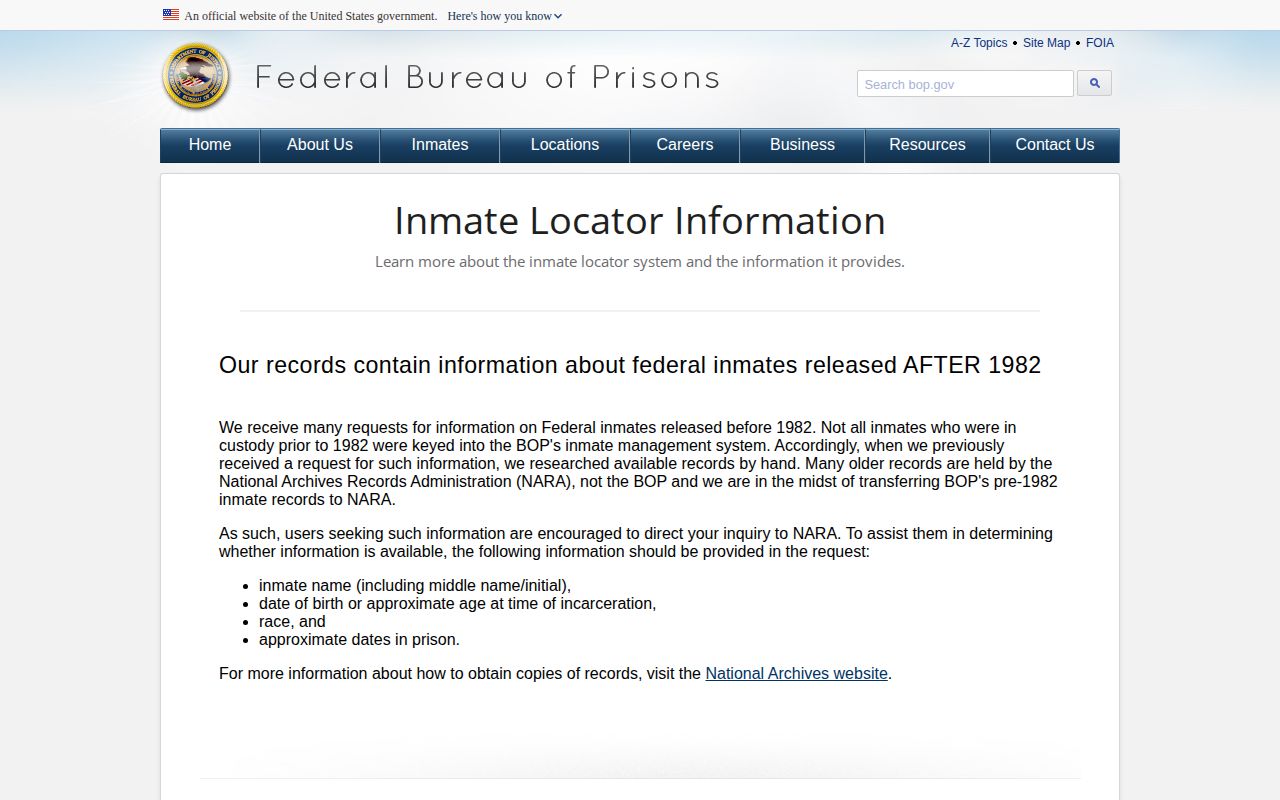
The BOP Inmate Locator generally includes federal prisoner records from 1982 forward. Search by register number when known. A name search can also use exact name and the available age, race, and sex filters. Compare the register number and identity fields before treating a match as the same person.
- Run the register-number search first when a BOP identifier is available.
- Otherwise search the exact first and last name and narrow the results.
- Open the matching record and preserve the displayed release date and status wording.
- Check the federal docket for sentence, later orders, and supervised-release terms.
- Follow any state, local, or immigration destination identified after BOP custody.
A result may show “Released” or “Not in BOP Custody” and a past date. Those terms concern BOP. BOP warns that the person may remain with another correctional, criminal-justice, or law-enforcement authority. A no-result can also reflect the pre-1982 record boundary, an identifier mismatch, or custody managed by USMS rather than BOP.
BOP Release Status Meaning
The official BOP locator explanation describes the record range and result meaning. It is essential context for a Lee County federal inmate release because a status without a current institution is not a universal freedom certificate.
- Released
- BOP reports that its custody ended on the displayed date.
- Not in BOP Custody
- BOP does not currently hold the person; another authority may.
- Supervised release
- A federal court-ordered period in the community after imprisonment, distinct from BOP confinement.
- Designation
- BOP’s assignment of a sentenced prisoner to an institution.
USMS Release Record Gap
USMS has no equivalent public historical inmate locator. A federal pretrial detainee may be held in a local jail and remain absent from BOP’s sentenced-prison search. If the person appeared at Sumter-Lee Regional Detention Center under federal authority, ask the regional records custodian for the booking and destination, then use the federal docket and USMS record route.
A docket entry can show detention hearings, bond decisions, judgment, sentence, commitment, and later court action. Yet a signed release or bond order may precede processing or another hold. Confirm the actual custodial event with the agency that held the person. After sentencing, a temporary lack of BOP location can reflect transport or pending designation rather than release.
The USMS FOIA route covers agency-record requests. Identify the person, federal case, district, date range, and specific custody or transport event. Privacy and law-enforcement limits may apply, so seek defined public portions.
Request Former BOP Records
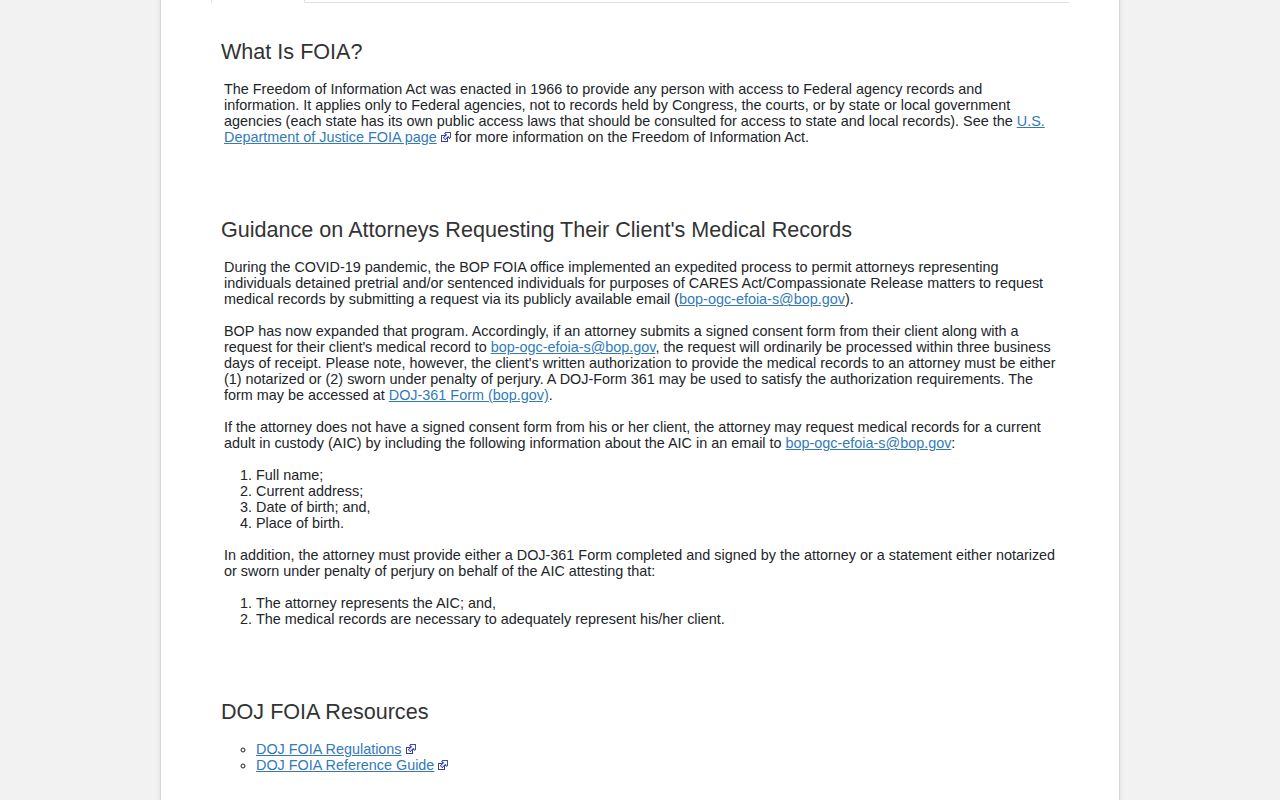
The BOP FOIA process is the documentary route when the locator is not enough. Ask for the former inmate’s public release-related record using full name, register number, date of birth, approximate incarceration or release period, and institution if known. Define the requested fields: actual BOP release date, release status, final institution, destination category if public, and relevant public sentence or movement entries.
The official BOP former-inmate records page explains the records-request channel.
Do not request broad protected personal, medical, security, victim, or third-party material. Privacy rules can limit disclosure. Ask for segregable public portions and an explanation of any withholding. Preserve the difference between a locator observation and an agency-produced record.
After Federal Prison Release
A BOP release can lead to federal supervised release, which is imposed by the sentencing court and overseen through the federal system. It is not South Carolina parole and should not be searched as though it were SCDPPPS supervision. The federal judgment and later docket entries are the starting records for the term and any modification.
Another possibility is transfer. A state warrant may send the person to a South Carolina or other state custodian. An immigration detainer may produce an ICE handoff. A county warrant may lead to a local jail. Use BOP’s end date as the starting point, then confirm the receiving agency’s date and status.
| After BOP | Verification |
|---|---|
| Federal supervised release | Federal judgment and docket |
| State custody | State DOC or receiving jail |
| ICE custody | ICE ODLS and ERO |
| No named transfer | BOP record plus court review |
Lee Federal Prison Confusion
Search results for “Lee federal prison” often surface USP Lee. That institution is in Lee County, Virginia. It is not Lee Correctional Institution in Bishopville, and it is not located in Lee County, South Carolina. Lee CI belongs to SCDC and holds state-sentenced men. The two systems have separate locators and release records.
A Lee County resident or defendant can still have a federal BOP record without any federal prison in the county. Federal custody follows the case and designation, not county borders. Use the nationwide BOP locator for sentenced custody and the federal case record for court action. Use the regional jail only when evidence shows a local placement.
The Lee County custody search overview compares local, state, federal, and immigration sources. Name the system in every conclusion to avoid attaching a Virginia prison result to a South Carolina record.
Federal Release Verification Standard
Keep every conclusion narrow and dated. A BOP match supports the displayed BOP status. A docket supports the filed legal event. A regional jail record supports local physical custody. An ICE or state record supports that agency’s custody. None alone establishes every later fact.
When sources conflict, prefer the direct custody-ending record and investigate timing. A court order may await processing. A locator can lag. A transfer can make one agency show release while the next shows custody. Ask for the actual timestamp and destination rather than treating a missing name as a final answer.
A clear federal result states that BOP released the person on the recorded date, that USMS or another custodian held the person at a specified stage, or that another agency received custody. It does not turn federal release into an unsourced claim about present location.
Federal Locator Record Fields
A BOP locator result presents a defined group of public fields: name, register number, age, race, sex, release date, and location or status. These fields help distinguish people with similar names and establish what BOP reports. They do not provide a complete criminal case file, the terms of supervised release, or the reason another authority may have taken custody.
Use a register number when possible because it is more precise than a name. For a name search, compare all available identifiers and avoid forcing a near match. Preserve capitalization and status wording from the live result. If a release date appears without a facility, report it as the BOP release date. Then check the federal judgment and later docket entries for supervision or a changed sentence.
Historic coverage generally begins with releases in 1982. An older federal imprisonment may be absent for that reason. A newer no-result can arise from spelling, identifier, pretrial, transfer, or agency-scope issues. USMS commonly controls people before BOP designation, so a BOP absence during a federal case may say little about current detention.
When requesting a former-inmate record, distinguish created records from questions. Ask for the public custody and release entries, not an agency opinion about where the person is now. Include the federal district and case number if known. If the final BOP record names another destination, contact that custodian and obtain its intake or status record. That second record completes the custody chain.
Federal Sentence and Release
Federal release dates differ from court hearing dates. A judgment establishes the sentence, and a later order can change it, but BOP calculates and records its custody event. A supervised-release term begins through the federal judgment framework and is not South Carolina parole. If a violation proceeding appears later, read it as a separate court event rather than rewriting the earlier BOP release date.
For a local contract placement, request the regional booking number, federal holding authority, admission and departure times, and destination. Compare that record with USMS transport information and the first BOP designation. This sequence can show that a person left a South Carolina jail for federal prison, even though the local database removed the name and BOP did not display a location at the same moment.
Public Record Search
Sponsored Results