
Lee County Release Meaning
“Released” describes the end of one agency’s custody. It does not always mean the person is free of all custody. A person leaving the Sumter–Lee Regional Detention Center may have posted bond, received a recognizance release, completed a local sentence, or obtained a court-ordered release. The same booking may instead end with a transfer to the South Carolina Department of Corrections, another jail, the U.S. Marshals Service, or immigration authorities. A transfer removes the person from the regional roster but continues government custody. The release reason and destination fields are therefore central to a sound Lee County release check.
A state-prison discharge follows a different path. SCDC controls moves, parole exits, community-supervision releases, and final discharges from Lee Correctional Institution. A move from Lee CI to another SCDC prison is not a release from SCDC. Likewise, a bond order from a Lee County court can authorize release while another warrant or detainer prevents the person from leaving. The safest proof joins the custody-ending record with a check of the likely next system.
| Recorded event | What it means | Where to check next |
|---|---|---|
| Bond or recognizance | Pretrial custody ends under court conditions | Lee court docket and regional release entry |
| Time served | A local custodial term is credited or complete | Sentencing order and release timestamp |
| Parole or community supervision | Prison custody changes to conditional supervision | SCDPPPS and SC VINE |
| Final discharge | The named agency records the sentence or custody as complete | SCDC released search or certified agency record |
| Transfer | One booking ends while another agency takes custody | The receiving jail, SCDC, BOP, or ICE |
Lee County Release Record Fields
A defined request produces better evidence than asking whether someone is “free.” For a Sumter–Lee booking, identify the person and the specific custody episode. Ask for the booking sheet and the release entry tied to that booking. Some fields may be redacted or absent from a public extract, but the request can seek each nonexempt portion. The record should be read as an agency event log, not as a judgment about the person or the criminal case.
| Field | What it shows |
|---|---|
| Name and identifiers | Distinguish people with similar names; may include booking or inmate number |
| Booking date and time | When the custody episode began |
| Releasing facility and agency | Which custodian ended its control |
| Actual release date and time | The logged end of that agency’s custody |
| Release type or reason | Bond, court order, time served, discharge, or another recorded basis |
| Destination or receiving agency | Whether the exit was community release or a custodial handoff |
| Hold or detainer disposition | Whether another legal basis affected departure |
| Booking photograph | The image linked to that particular regional booking, if releasable |
An SCDC record contains a different field set. Public portions can include aliases, identifiers, committing county, offense and sentence, sentence start, jail credit, admission, eligibility dates, projected release date, adjustments, transfers, detainers, institution assignment, and status. SCDC policy keeps home address, Social Security number, clinical data, victim information, and other protected material confidential. A narrow request for the final release authorization, actual date and time, release certificate, court order, and any temporary-custody receipt is more useful than requesting the whole file.
Request Lee County Release Records
Regional jail records belong with the Sumter-side detention custodian, even when the arrest happened in Lee County. Call the Sumter–Lee Regional Detention Center at 803-436-2340 to confirm the current records address or email before sending a request. The Lee County Sheriff’s Office is the separate source for its own arrest and incident material. South Carolina’s Freedom of Information Act allows inspection or copying of public records subject to exemptions and permits a requester to seek segregable, nonexempt portions.
- Give the full name, date of birth if known, booking number, arresting agency, and an approximate booking or release range.
- Ask for the booking sheet, admission and release timestamps, release type, transfer destination, recorded hold disposition, and the booking photo tied to that event.
- State that electronic delivery is preferred and that nonexempt portions should be produced if another part is withheld.
- Ask for an itemized estimate before costs exceed a limit you set. No verified regional booking-photo fee was found.
- Compare the response with the court order and any receiving-agency record before treating the exit as community release.
For records less than two years old, the statute generally provides ten business days for an initial determination. Older records generally receive a determination within twenty business days. Production periods, lawful extensions, fees, exemptions, and a deposit of up to 25 percent are governed by the current statute. Those timing rules are not a promise that an agency will answer the underlying custody question by phone.
The SCDC legal-information page gives a separate state-record route through its FOIA Coordinator. This official screen shows where a focused sentence or release request belongs.

SCDC’s posted copy and staff-time charges apply to its records, not to the regional jail or Lee courts. Verify the current schedule before filing.
Find Lee County Released Inmates
Start with the prior custodian. A Lee County arrest usually points to the Sumter–Lee Regional Detention Center and its current Zuercher portal. A state sentence points to SCDC. A federal sentence calls for the BOP locator, while a federal pretrial placement may require the court docket and U.S. Marshals Service. An immigration handoff calls for ICE’s locator and the responsible ERO office. Court records show the legal case event, not the exact moment a person walked out.
- Search the regional current roster and SC VINE for a local Lee arrest. Treat a missing name as a lead only.
- Call the regional detention center and ask whether the booking ended in release or transfer, then request the defined release entry.
- Search the Lee County Public Index for bond, disposition, sentence, and later warrant or violation entries.
- If state custody is plausible, compare the SCDC current-only search with the separate SCDC Released Inmate Search.
- Check SCDPPPS or SC VINE for supervision, and check BOP or ICE when another sovereign may have received custody.
A released person usually drops off the live jail roster, so absence must be followed by a release record or receiving-agency check.
Lee Release Records Span Counties
Lee County’s local custody system crosses county lines. People arrested by the Lee County Sheriff or Bishopville Police may be booked at the Sumter–Lee Regional Detention Center at 1250 Winkles Road in Sumter. Their criminal cases are still searched under Lee in the South Carolina Public Index when Lee is the court jurisdiction. This split explains why a search confined to a “Lee County jail” label can fail even when the booking and case are both official.
The two records answer different questions. The court docket may show a bond order, dismissal, sentence, or later violation. It does not prove the exact physical-release time. The regional jail entry can show when its custody ended and may show a receiving agency. When the records appear to conflict, use the court order as the legal authority and the release entry as the custody event, then ask whether a separate hold delayed or redirected the exit.
Lee SCDC Released Inmate Search
South Carolina maintains two SCDC tools with sharply different scopes. The ordinary search covers people currently sentenced to and incarcerated in SCDC as of midnight on the prior day. It excludes released people, county-detention sentences, parole, probation, community supervision, juveniles, and current SCDC fugitives. No result is expected after an SCDC release. It should never be used to erase a known state-prison history.
The separate SCDC Released Inmate Search is the stronger released-first route. Enter a beginning and ending release date, choose County, and use the optional sex-offender filter only when relevant. Results appear ten at a time, and Export provides detailed output. Read the live headings before deciding what “County” means; it must not be assumed to mean the institution, arrest county, or destination without the agency’s definition.
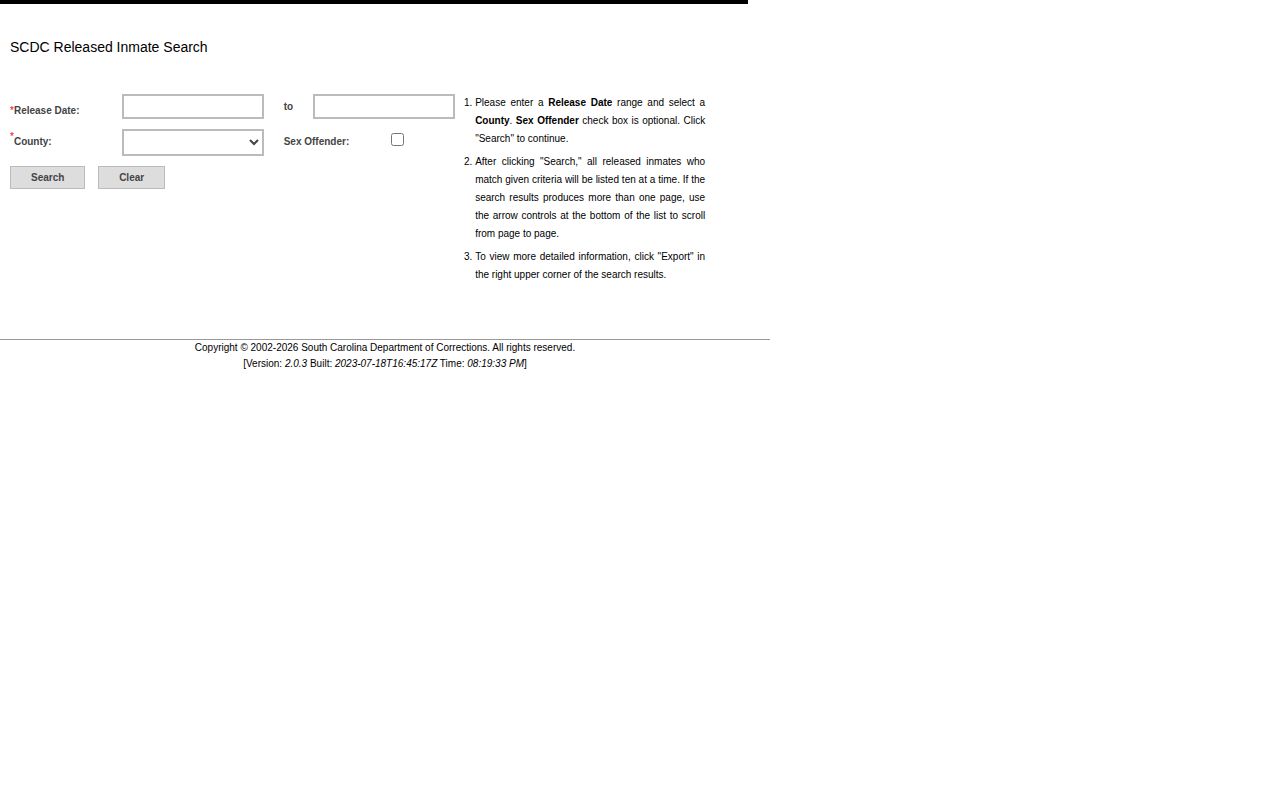
The official screen makes the date range and county filter visible. Compare names and identifiers, preserve the agency’s status wording, and use the export or a records request when documentary detail is needed.
| Search field | Use | Limit |
|---|---|---|
| Release date from | Starts the completed-release interval | Required by the released tool |
| Release date to | Ends the completed-release interval | Required by the released tool |
| County | Filters the agency dataset | Do not guess the field’s geographic meaning |
| Sex Offender | Optional filter supplied by SCDC | Not a general release-status field |
| Name or SCDC number | Used in the current-custody interface | The current tool excludes released people |
Which Lee Release System Applies
Lee Correctional Institution is a close/medium-security male SCDC prison in Bishopville that opened in 1993. It is not the Lee County jail. Its prisoners come from the statewide sentenced population, while local Lee detainees are served by the regional jail in Sumter. The shared “Lee” name can send a search to the wrong agency and produce a false conclusion about custody or release.
| System | Who it covers | Correct release path |
|---|---|---|
| Sumter–Lee Regional Detention Center | Lee local detainees and other regional bookings | Regional release entry, VINE, and Lee court docket |
| Lee Correctional Institution | Statewide-sentenced men assigned by SCDC | SCDC released search, SCDPPPS, and SCDC records |
| Federal custody | People held or sentenced under federal authority | BOP locator, federal docket, and USMS where applicable |
Searches for “Lee federal prison” can also surface USP Lee. That prison is in Lee County, Virginia, not Lee County, South Carolina. No BOP prison was identified in this South Carolina county. A federal case connected to a Lee resident should be traced nationally through BOP and the federal case record.
Lee County Recent Release Check
No official Sumter–Lee or Lee County web page was verified as a rolling 24-hour or 72-hour release feed. The regional Zuercher portal is a current-incarceration list. Its official references do not promise an archive, refresh interval, release reason, or post-release retention window. Current detainees must not be presented as people who were just released.
For a same-day window, search the live portal and VINE, call 803-436-2340, and request the release log for an exact 24-hour range. For a three-day window, use exact start and end timestamps in Eastern time so the interval does not move while the request is processed. Ask for names, booking numbers, booking and release times, release types, and receiving agencies, subject to lawful redaction. The dedicated Jail Releases: 24 Hours page focuses on that narrow recent-release task.
Lee Bond and Release Desks
Lee County Bond Court is at 115 Gregg Street in Bishopville, while the detention operator serving Lee is contacted in Sumter. A judge’s order and the physical departure record therefore come from different desks. The court can explain the filed bond action. The regional detention custodian can document when its booking ended and whether another hold affected departure.
A bond entry is not a final disposition and says nothing by itself about guilt. Another case, warrant, detainer, or transfer can keep custody in place after the order. Ask the jail whether all holds were cleared and whether a receiving agency took custody. When a timestamp matters, obtain the release entry instead of inferring it from the docket posting time.
Lee Release Supervision and Alerts
SCDPPPS maintains a Lee County office in Bishopville and supervises parole, probation, community supervision, and other listed programs. Probation is a court-ordered community sentence or condition. Parole is conditional release from prison before the sentence fully ends. A person can begin probation without ever entering SCDC, while a released state prisoner may move into parole or mandatory community supervision. Neither belongs in SCDC’s current-prison search.
SC VINELink can bridge the participating county detention, SCDC, and SCDPPPS layers. Search by name or offender number, compare identifiers, read the reporting agency, and preserve the last-update information. A transfer may require a new notification registration. For SCDC crime-victim notification, the SC VINE FAQ directs registration through SCDC Victim Services rather than relying on a generic web watch.
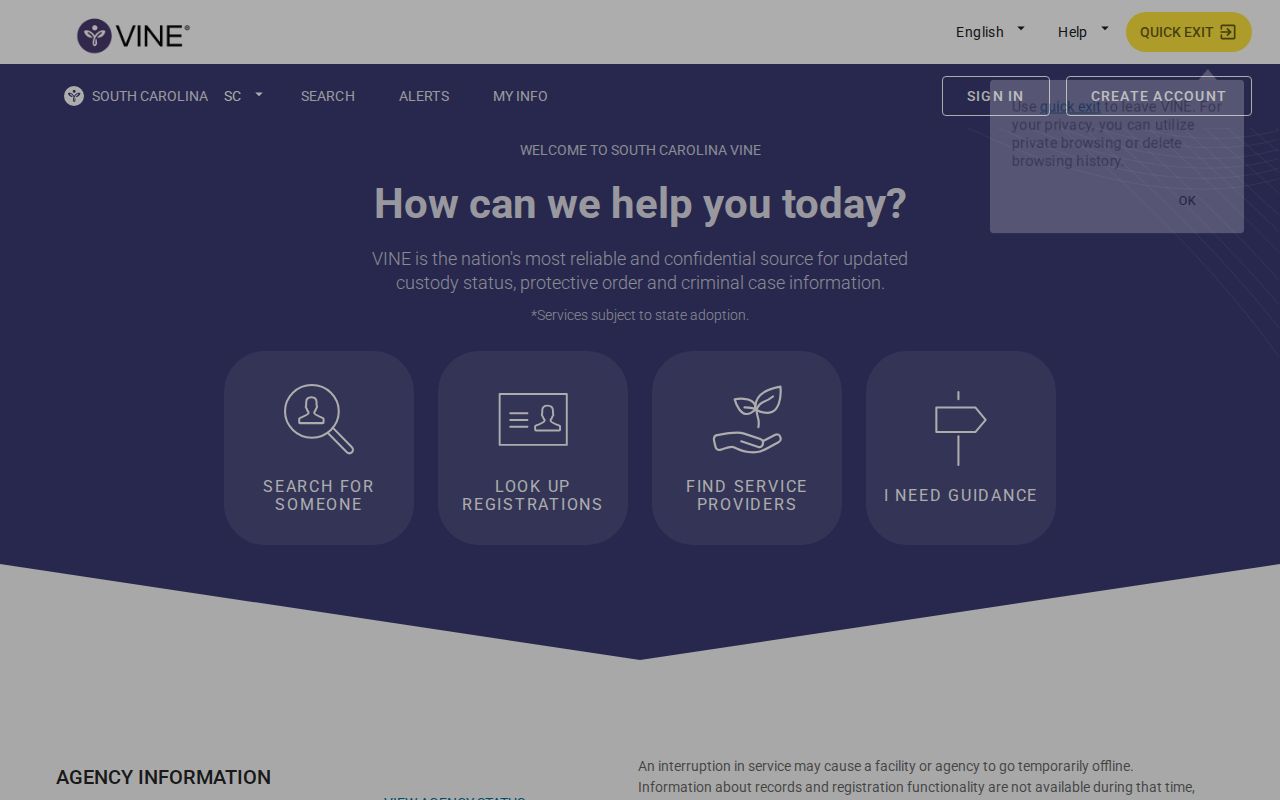
The state search screen helps locate a specific record across participating agencies, but VINE remains a notification tool. Documentary proof comes from the originating custodian.
Lee State Release ID Property
SCDC policy adds an identity and property step to a state-prison release. Personal identification and belongings kept in the institutional record are returned before departure, and the released person receives an SCDC identification card with an official release sticker. This is an SCDC process. No equivalent Sumter–Lee jail policy was verified, so it should not be assumed for regional releases.
The distinction matters when someone expects documents or property after leaving Lee Correctional Institution. Institution staff can address a facility-specific handoff, while central SCDC records prove the release event. A regional detainee or family member should call the detention center and ask about its current property process rather than relying on the state-prison rule.
Lee Release Detainers and Transfers
SCDC’s final release audit checks detainers. Its policy also documents a temporary-custody receipt when another law-enforcement agency receives the person. Leaving Lee Correctional Institution can therefore be a custodial handoff instead of a return to the community. The same principle applies when the regional jail reports release to SCDC, USMS, another county, or ICE.
ICE calls a request to hold or notify about a potentially removable person a detainer. A county booking can end when ICE custody begins. Check the ICE Online Detainee Locator and the responsible ERO office, but treat an absent locator result cautiously. Transfers, removal, protected records, and identifier errors can affect visibility. The destination field and receiving-agency record are more probative than roster disappearance.
Getting Home After Lee Release
Santee Wateree Regional Transportation Authority publishes Lee County Transit information from 5 Courthouse Square in Bishopville. Its listed service includes three free Bishopville loops on weekdays and demand-response trips between Bishopville and Lynchburg on Tuesday and Thursday. These routes may help after a person has returned to Lee County.
The transit source does not establish pickup at the Sumter–Lee Regional Detention Center. Nor did the research verify jail-arranged transport, a release exit, or a standard time of day. Confirm the actual release location and time with the detention center, then check the current transit schedule and pickup rules. Do not send someone to wait at a facility based on a projected date alone.
Lee Release and Expungement Differ
Release does not erase the arrest, booking photograph, or court case. A dismissal, acquittal, expungement, sealing order, and release are separate events with different legal effects. Under South Carolina Code §17-1-40, qualifying booking records, mugshots, and fingerprints can be destroyed or held under sealed statutory rules. Sealed material is not public. Eligibility and procedure depend on the case, so the filed disposition and current law control.
Section 17-1-60 targets businesses that obtain booking material while demanding payment for removal or revision. It also provides a qualifying certified-mail removal or correction process for specified outcomes. It is not a blanket ban on every booking photo. The official South Carolina expungement process should be used instead of assuming that a person’s release alone removes public records.
Lee Released Versus Current Custody
Each system answers a narrow custody question. Match the record to the agency and time period before drawing a conclusion.
| Source | Best use | What it cannot prove alone |
|---|---|---|
| Regional current portal | Present listed jail custody | Why or when a removed booking ended |
| Regional release entry | Actual local custody-ending event | Freedom from a receiving agency |
| SCDC current search | Prior-midnight state-prison custody | Released SCDC history |
| SCDC released search | Recorded completed SCDC release in a selected range | End of later supervision or other custody |
| Lee court docket | Bond, disposition, sentence, and later case events | Exact physical departure time |
| BOP locator | Federal BOP status and past release date | Other sovereign custody or supervised release |
Lee County Release Facilities
The release path follows the custodian, not the county name. The regional jail is the primary local detention route. Lee Correctional Institution and the SCDC system cover state prisoners. Law-enforcement pages distinguish arrest records from jail release records, while the federal and ICE pages explain nationwide custody systems.